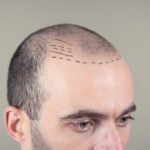
I get the following message very often from the patients via Whatsapp or Instagram DM etc:
“Doctor, how many hair grafts do I really need?”
This question is hard to answer with a single message.
We should remember that there is not a universal standard that fits to every patient. Two patients with similar hair loss patterns may need different graft numbers to achieve a natural looking and satisfying result.
As a plastic surgeon, i never simply focus on translanting as many grafts as possible. Instead, I focus on gaining the best long-term result while preserving the donor hair for the future sessions.
The number of hair grafts is decided after checking the following factors:
- Norwood stage,
- The size of the hairless or thinned area
- Expected Density
- Donor Capacity
How Does the Norwood Scale Affect How Many Hair Grafts You Need?
Even i dont think that it is an exact scale, we do check the Norwood Scale of the patients first.
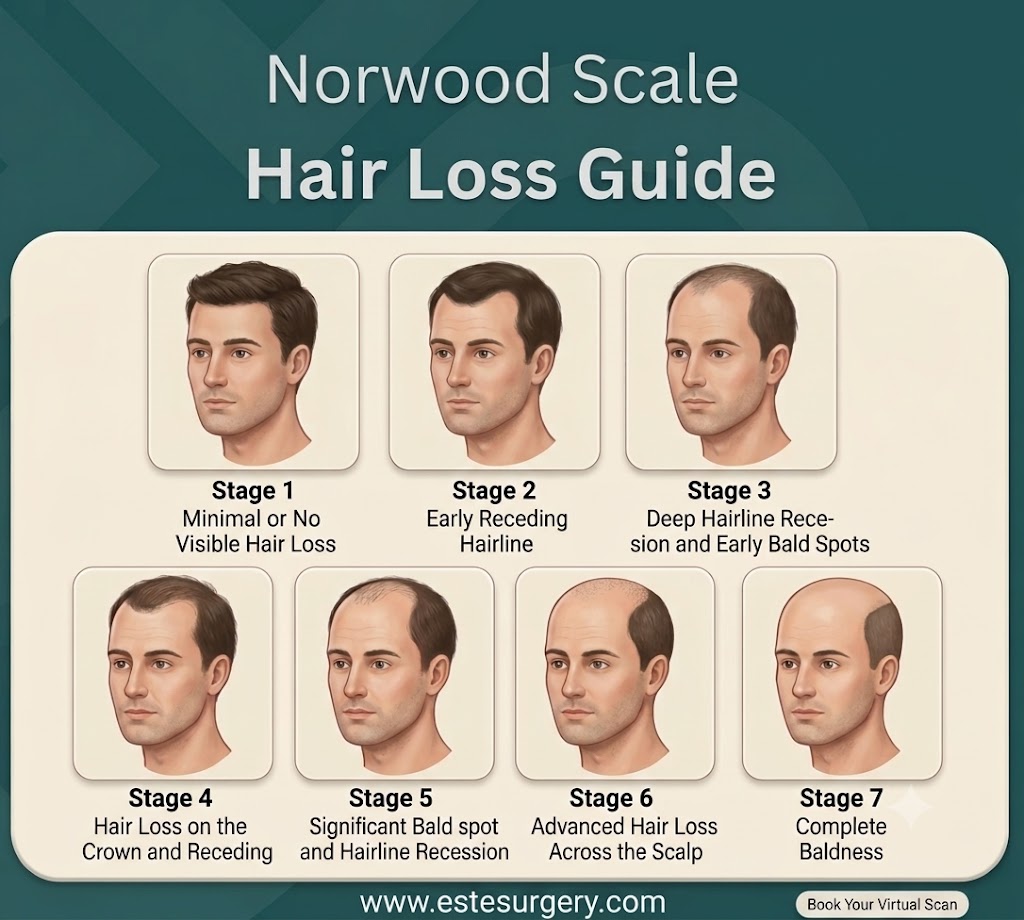
The Norwood Scale is the most commonly used classification system for hair loss. There are basically 5 stages of norwood scale and it is approximately as in below:
- Norwood 2: 1,000 to 1,500 grafts
- Norwood 3: 1,500 to 2,500 grafts
- Norwood 4: 3,000 to 4,000 grafts
- Norwood 5: 4,000 to 5,500 grafts
- Norwood 6-7: often more than 5,500 grafts depending on donor capacity
However, the Norwood stage does not determine the graft quantitiy alone, it is just a referrence.
Two patients with the same Norwood level may need different graft numbers as they may have different donor characteristics, hair thickness, and ages and personal expectations. If you are making online research to find an answer to “how many hair grafts do i really need?:” this may work. But still you need a personal assesment by a plastic surgeon fort he exact plan.
How Many Hair Grafts Are Needed for Different Areas of Hair Loss?
Basically how many grafts you need depends on the size of the hairless area.
A patient seeking just a hairline restoration needs less grafts than someone who lost most of his hair in the frontal area or crown area.
Here i want to share a general estimate for each areas:
- Hairline restoration requires 1,500 to 2,000 grafts.
- Frontal area reconstruction may require between 2,500 – 3,500 grafts.
- Crown restoration usually requires an additional 2,000 – 3,000 grafts.
- If you need extensive frontal, mid-scalp and crown coverage all together than at least 5000 Grafts must be transplanted.
The crown area alwats deserves special attention because it generally requires more hair grafts than expected beucase of its circular shape and whorl pattern. Even you need transplant highes graft number to this area, the survival rate is the lowest in this area due to weak blood circulation.
For this reason, i personally prioritise the frontal area first. Beucase restoring the frontal zone seriously improves your general outlook. Even your crown is still open or has lower density you may get a younger look with a good coverage of frontal area.
What Hair Density Can You Achieve with Different Numbers of Hair Grafts?
Many people think that if you transplant more grafts then you have a higher density and better results.
Actually, it is not true always.
We have 80-100 hair grafts in 1cm2. This is the original density. It is impossible to replicate the original densitu and there is no need fort his as well.
Interestingly, the human eye can not distinguish the density. Fulness is comes first. It is possible to have the same full look with only 30-35 grafts per 1cm2.
However, there is a strategic key here. We need to adjust the hair density for each part of the head very carefully and in a smart way.
Higher density is always better in:
- The frontal hairline
- The forelock area
- The central frontal zone
While, slightly lower densities can still give you natural look and satisfying results in:
- The mid-scalp
- The crown
Hair restoration is not simply about number of graftts. It is a combination of surgical precision and artistic planning.This requires a lot of experience!

How Does Donor Capacity Affect the Number of Hair Grafts You Can Have?
We can say that the donor area is our hair bank.
Just like any bank account, resources are limited.
Every graft which we extract today is a graft that we cannot use in the future. That is why responsible donor management is one of the most important principles of successful series of hair transplantation surgeries.
There are several factors which influence donor capacity:
- Donor density
- Hair thickness
- Hair colour
- Hair curl characteristics
- Scalp flexibility
- Future hair loss progression
Patients who have thick and curly hair generally achieve excellent visual coverage with even small number of hair grafts.
On the other hand, patients ho have fine and straight hair may require a higher number of hair grafts to get the same density and appearance.
In younger patients it is even more important to protect the donor reserves, because male pattern hair loss often continues to progress over time even until 60s.
A successful hair transplant procedure should not only solve today’s immediate problem but also preserve possible options for the future.
Does Having More Hair Grafts Mean Better Hair Transplant Results?
This is the biggest misconceptions in the hair transplant industry. I say industry because a doctor always knows that the best result is not about number of grafts. However, some amatours offer maximum hair grafts claiming they deliver the best results.
This is simply not true.
Aggressive extraction can damage the donor area and compromise future treatment options.
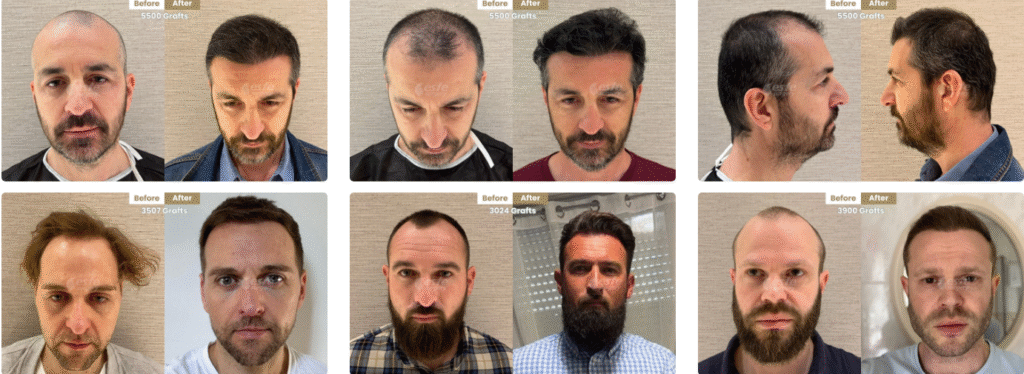
In many situations, you can produce better long term results with 3500 carefully planned grafts compated to 5,000 poorly distributed grafts.
The objective should never be maximum extraction. This is wasting you resources.
We can say that a successful hair transplantation depends on followings:
At Este Surgery, i always aim the be maximum naturalness not maximum grafts.
- Proper surgical planning
- Natural hairline design
- Strategic graft distribution
- Responsible donor management
There is a popular saying: “Quality is always more important than quantity.”
So, How Many Hair Grafts Do I Really Need?
Ultimately, the answer depends entirely on you.
The ideal graft number is determined by:
- Your Norwood stage
- The size of the recipient area
- Your density expectations
- Your donor capacity
- Whether you keep loosing you hair or not
Online graft calculators can only give you and idea and rough estimates.
For the ideal treatment plan which is tailored to you can only be decided after a detailed consultation with an experienced plastic surgeon.
The best hair transplant is not the one with the highest number of grafts.
It is the one that looks natural, preserves your donor area, and continues to look good for many years to come.